In this article 10 sections
- What the bottom is telling you about the top
- Twice a year is the minimum
- Read the top of the building from the ground
- What neglect costs
- Settle who is responsible before the first leak
- Keep ladders out of it
- What a proper ground-level clear looks like
- Check for nests before you start
- When to call us
- Gutter and drain questions:
In short
- What you see at the foot of a downpipe is the best case. If the bottom is neglected, the gutter, fascia and roof edge above are worse.
- Clear gutters and downpipes twice a year, in late autumn and in spring. Once a year is not enough on a site with trees.
- Keep your own team on the ground. If the job needs a ladder or a roof, it needs a specialist.
Weeds in the outlet and a green stain on the wall are what you can see from the ground. The gutter, fascia and roof edge above are almost always worse, and nobody is looking at them.
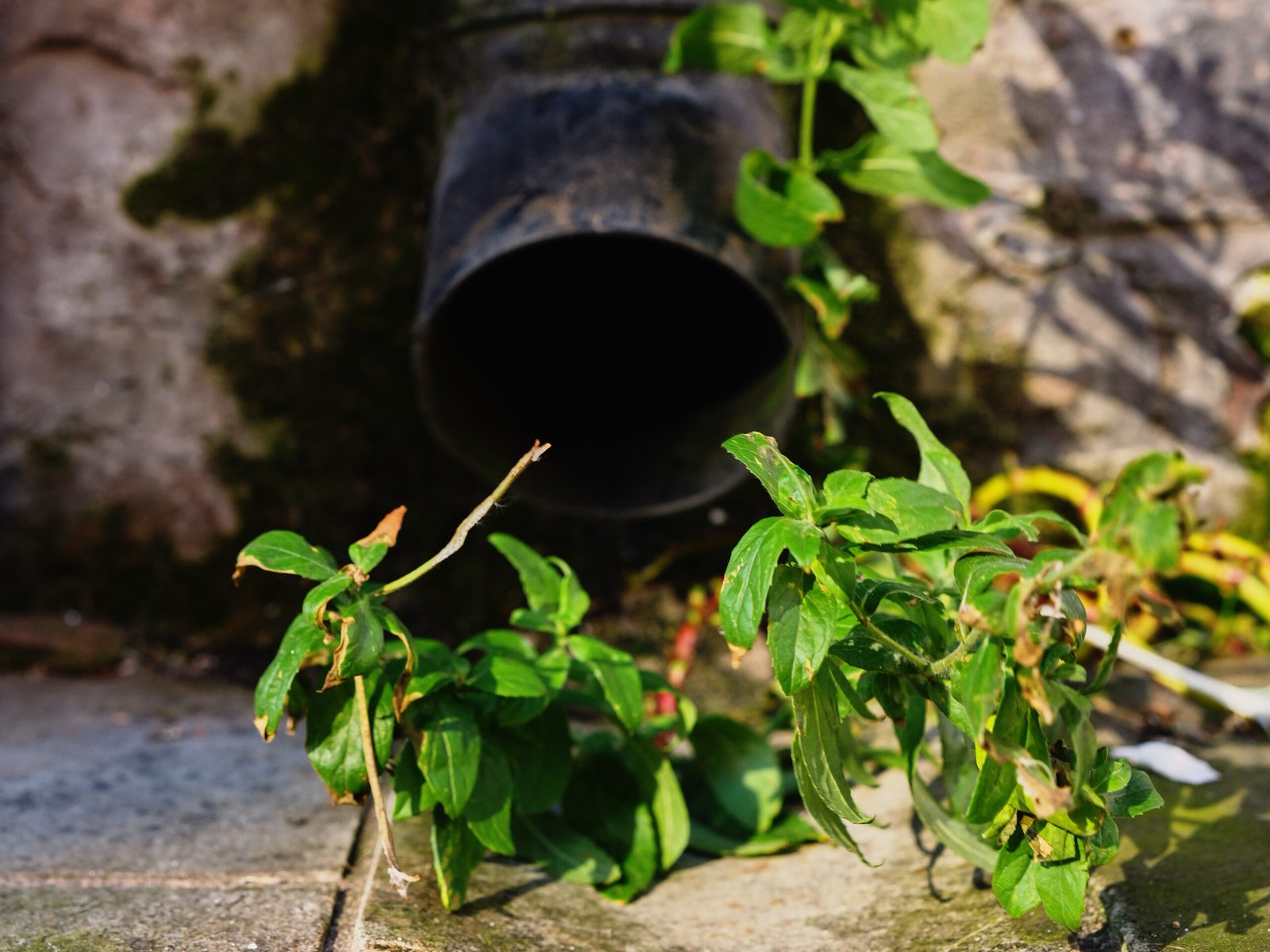
Look at the foot of any downpipe on a commercial site. A weed growing out of the outlet, a green stain climbing the wall, a puddle that never dries. That is the part you can see from the pavement, and it is the best case. If the bottom looks like this, the top is worse.
Gutters, roof edges, fascias and soffits do their work out of sight, so they are ignored until something drips. By then the silt has been building, water has been standing in the channel and finding the weakest joint, and the damage is above head height, where nobody is looking. Below is what we think is going on up there, how to tell from the ground, and what we would do about it.
What the bottom is telling you about the top
Water that reaches the ground has already been through the gutter, the joints and the downpipe. If it arrives carrying silt, moss and seeds, and leaves weeds and green growth behind, all of that came from above. A weed growing out of an outlet needed soil, and the soil came off the roof.
Up there, the picture is usually the same, only worse: a channel packed with silt and rotting leaves, plants rooted along the back edge, water standing where the fall has been lost, joints weeping, and brackets carrying a weight they were never designed for. Standing water is what rots fascias and soffits, stains the brickwork under every joint and gives birds a damp, sheltered gap to nest in. None of it is visible from the car park until it fails.
That is why we treat the bottom of the downpipe as a free inspection. It costs nothing to look, and it tells you whether the rest of the system has been cared for.
Twice a year is the minimum
The common advice is to clear gutters every autumn. We would go further and do it twice, and stop treating the second visit as optional. Autumn deals with leaves. Spring deals with what the winter left behind: silt in the channel, moss along the back edge, seed heads and the first nests.
Timing matters more than most people think. A clear in October is undone by three weeks of wind, because leaf drop in the North West often runs into late November or early December. We book the autumn visit for when the trees are mostly bare and before the first long wet spell, not for a date in the calendar.
Some sites need more. Mature trees overhanging the roof, box gutters behind a parapet and flat roofs that drain through a single outlet all fill faster than a plain pitched roof. If one of those describes your building, plan a third visit and a quick check after the first named storm.
Read the top of the building from the ground
You do not need to climb anything to know a gutter is struggling. Walk the building in heavy rain, then again on a dry day, and look for these. Each one points at something you cannot see from where you are standing:
- Water pouring over the front edge of the gutter instead of running to the outlet.
- Green or brown streaks on the wall below joints, corners and hoppers.
- Plants or moss growing in the channel, or grass sprouting at the outlet.
- A sagging run, or brackets pulling away from the fascia.
- A downpipe that runs dry in a downpour, or leaks at its joints.
- Standing water, silt or weeds at the foot of the pipe, as in the photo above.
- Damp patches or peeling paint on the inside of the wall, close to the line of the gutter.
Tip: take photos during the rain walk. A dated picture of water coming over the gutter edge makes a quote, a service request or a conversation with your landlord far quicker.
What neglect costs
Water does not stay where you want it. When a gutter overflows, it runs down the face of the wall, soaks the brickwork and works into the mortar. Moss and algae follow, then damp inside, then a repaint that did not need to happen. All of that is avoidable with a few hours of clearing twice a year.
The repair bill is not the whole cost. A green wall and a stained entrance tell every visitor that nobody is looking after the building. And water that lands on steps and paths makes them slippery, which is where the injuries are: slips, trips and falls on the same level account for around 30% of non-fatal workplace injuries in Great Britain. In a cold snap, overflow freezes exactly where people walk in.
Settle who is responsible before the first leak
Most gutter disputes happen because the lease says nothing clear, so the landlord assumes the tenant clears them and the tenant assumes the landlord does. Read the repairing and maintenance clauses before autumn. On multi-let buildings, ask in writing who clears the gutters and who pays, and whether it is covered by the service charge.
Drains follow a similar logic. Pipes that serve only your building and sit inside your boundary are normally yours to keep clear. Many shared and lateral drains outside the boundary passed to the water company in 2011, so a blockage beyond your boundary is usually a call to them. If the lease or a drainage survey is unclear, get it clarified before the winter, not during it. This is general guidance, not legal advice.
Keep ladders out of it
This is the part where we are most opinionated. We would not send a caretaker or a site operative up a ladder to clear a commercial gutter, and we would not let anyone walk onto a roof to reach one. The savings are small and the downside is a fall.
The numbers back that up. In 2025/26, 31 of the 126 workers killed in work-related accidents in Great Britain died in falls from height, according to HSE’s provisional figures. HSE’s own guidance is that a ladder suits low-risk work of short duration, with around 30 minutes at a stretch as the upper limit. A gutter clear with debris, wet silt and a bucket does not fit that description. On a roof, the rule is to treat every roof as fragile until a competent person says otherwise, and rooflights are the ones people miss.
So the line is simple. Ground-level work with a pole, on a low run, can be done in-house. Anything higher goes to someone with the right access: a pole-wash system reaching 20 metres, a platform, a MEWP, a cradle or rope access. Keep poles well clear of overhead cables whichever side of the line you are on.
What a proper ground-level clear looks like
For low gutters on units, extensions and single-storey buildings, a pole with the right head does the job. The head matters more than most people expect: a head that does not match the gutter profile skates over the silt and leaves it behind.
Match the head to the profile. The Pro Gutter Square Attachment (£7.25 excl. VAT) suits the box-section gutters on commercial units and newer buildings, where silt packs into the flat base and corners. The Pro Gutter Half Round Attachment (£7.25) is the one for the curved gutters on schools, small offices and older units. Older and heritage buildings with S-profile gutters need the Pro Gutter Ogee Attachment (£7.25), because a flat head misses the stepped ridges where moss and grit collect.
Corners and joints collect the most debris and slow the water the most. The Pro Gutter Angle Attachment (£9.99) is shaped for exactly that. Where narrow channels and slim outlets silt up, the Pro Gutter Mini Flo Attachment (£7.25) flushes them with a water feed. All five heads share one fitting, so they swap on the same pole. If you are not sure your pole takes them, call 0844 504 5155 and we will confirm before you order.
- Walk the run first and look for nests, wasps and loose sections. Stop if you find any (see below).
- Lift out large leaves and clumps by hand, wearing gloves.
- Draw the head along the channel towards the outlet, working in short sections.
- Flush the run with water and watch it travel.
- Check the downpipe: water should leave the outlet freely, with no leaks at the joints.
- Clear the base: lift the grate, remove silt and weeds, and scrub the moss off the paving.
- Bag everything and take it off site.
Step four is the one most clears skip. If water has not been seen leaving the outlet, the gutter has been tidied, not cleared. And step six matters because a spotless gutter that drains onto a blocked gully still floods the path.
For the base and the bagging, the kit is simple. The 12″ Stiff Brush (£3.75) lifts moss and silt off paving and out of joints. Heavy duty rubble sacks (£12.61 for a case of 100) take wet silt and twigs without splitting. Waterproof Thermal Nitrile Gloves (£5.50) keep hands dry and warm.
Check for nests before you start
Gutters, soffits and roof edges are where birds nest, mostly from spring into late summer. It is an offence to intentionally or recklessly damage or destroy a wild bird’s nest while it is in use or being built, so an active nest means you stop and wait, whatever the gutter looks like. If birds keep returning to the same gap, the fix is proofing the entry point, not clearing the nest every year. Our pest control team advises on bird proofing around roofs, ledges and external structures.
When to call us
Call a specialist when the work is above ground-level reach, when there is a fascia or soffit to wash, when you have a flat roof or box gutter, or when nobody on site wants the job. Our window cleaning team clears and flushes gutters, washes fascias and soffits on the same visit and photographs the result, using whichever access method suits the building: pole-wash to 20 metres, a MEWP, a cradle or rope access where needed. On a planned contract, we typically clear gutters and fascias twice a year.
A good gutter clean should be cleared, flushed and photographed. If a quote does not say all three, ask what is missing.
We work across Liverpool, Merseyside, Cheshire, the North West and North Wales. Call 0844 504 5155 (Monday to Friday) or request a quote and we will arrange a site review.
Gutter and drain questions:
How often should commercial gutters be cleaned?
Twice a year at the minimum: late autumn, after most of the leaves have dropped, and in spring. Sites with overhanging trees, box gutters or flat roofs need extra visits.
How much does commercial gutter cleaning cost?
It depends on the length of the run, the height, the access method and the condition of the gutters. A ground-level clear costs far less than one that needs a platform or a MEWP.
What is the difference between gutters, downpipes and drains?
The gutter collects water from the roof edge. The downpipe carries it down the wall. The gully or drain at the foot takes it away. A blockage in any one of the three has the same result, which is why we check all three.
Why is water running down my wall?
Almost always because the gutter above is overflowing, leaking at a joint or pulled away from the fascia. The green streaks under the joint tell you which. Clear the gutter, check the joint, and look at the fall of the run.
Why is the water backing up at the bottom of my downpipe?
The gully or drain at the foot is blocked, usually with silt, leaves and weeds. If it still stands after you clear the grate, the pot underneath is probably full and needs a drainage contractor. We can flag it during a site review.
Do gutter guards mean I can stop cleaning?
No. Guards on outlets reduce what gets through, which helps, but silt still builds up along the channel and the guard itself clogs. Check them at the same visits.
Do you clean fascias and soffits?
Yes. They are washed down on the same visit as the gutter clearance, which is cheaper than coming back for them.
Do you cover my area?
Liverpool and Merseyside are our home patch, with regular contract runs across Cheshire, Wirral and the North Wales coast.